
Coordinated by IRTA and funded by Horizon Europe, the four-year project will combine crop genetic diversity, artificial intelligence and on-farm experimentation to help European agriculture adapt to increasing environmental pressures.
LLEIDA, SPAIN – 19 October 2026
European farmers increasingly face a complex challenge: crops must withstand not just drought or heat, but combinations of environmental stresses, often accompanied by pests and disease. As climate conditions become more unpredictable, developing varieties and farming systems capable of coping with these challenges is becoming essential for sustainable food production.
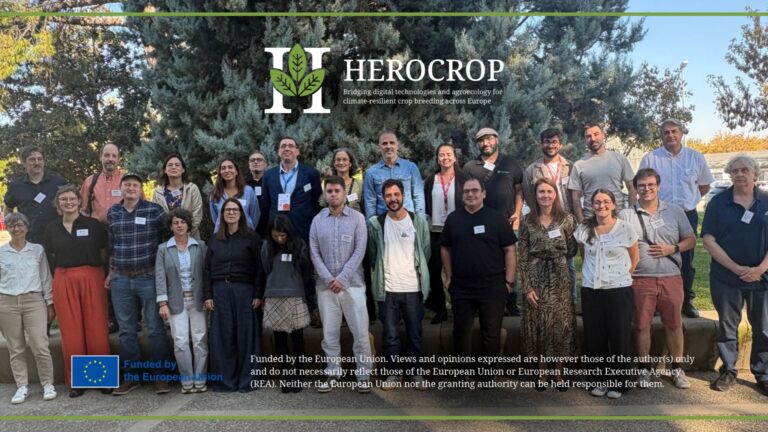
To address this challenge, 14 partner organizations from 11 countries have joined forces in HEROCROP, a four-year European research and innovation project coordinated by the Institute of Agrifood Research and Technology (IRTA). The consortium officially launched its activities during a kick-off meeting held in Lleida, Spain, on 15–16 October 2026.
HEROCROP aims to transform how crops (wheat, pea and tomato) are bred and managed by moving beyond traditional approaches that consider environmental stresses individually. The project will investigate how crop genetics, environmental conditions and agricultural practices interact to determine crop performance under multiple stresses, using this knowledge to develop more resilient varieties and sustainable production strategies.
Why wheat, pea and tomato?
HEROCROP focuses on three crops with complementary roles in European agriculture: wheat, pea and open-field tomato. Wheat is one of Europe’s most important staple cereals and a major contributor to food security. However, its productivity and grain quality are increasingly challenged by drought, heat and emerging diseases.
Pea is an important source of plant protein for food and feed and contributes to more sustainable farming systems through biological nitrogen fixation, which can reduce the need for mineral nitrogen fertilizers. Improving its resilience could also support crop diversification and more sustainable rotations.
Open-field tomato represents an economically important horticultural crop, particularly in Mediterranean agriculture, where water scarcity, high temperatures and pest and disease pressures threaten productivity and quality.
Together, these crops provide contrasting biological and agricultural systems through which HEROCROP can investigate how resilience can be improved across different species promoting diverse cropping systems, growing environments and management practices.
Combining genetic diversity, advanced technologies and agroecology
At the heart of HEROCROP is the integration of crop genetic diversity, advanced phenotyping, plant stress biology and artificial intelligence.
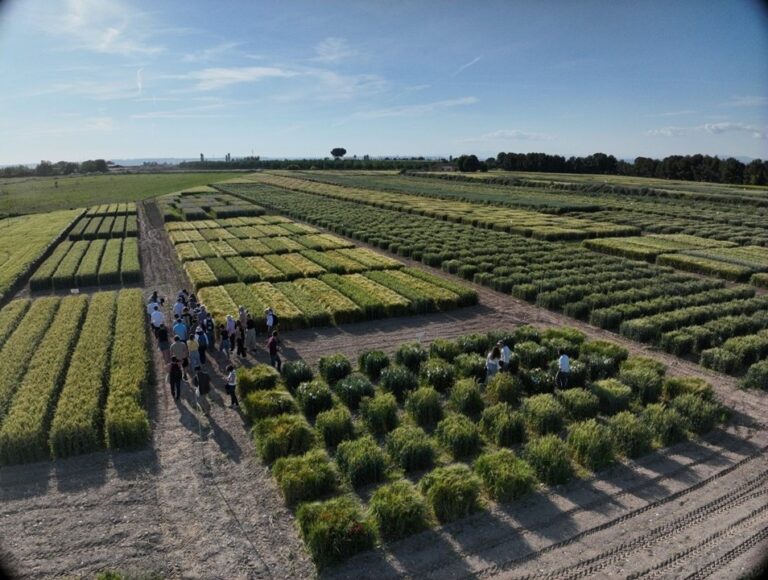
The consortium will evaluate more than 2,000 genetic accessions, including traditional landraces and locally adapted varieties, to identify traits and mechanisms that contribute to resilience against multiple environmental stresses. These genetic resources may contain valuable adaptive characteristics that can be incorporate into future breeding programmes.
By combining field experiments, high-throughput phenotyping and molecular analysis, researchers will investigate how crops respond to interacting stresses, including the effects of their timing, intensity and sequence.
This knowledge will support the development of Genotype x Environment x Management (GxExM) Digital Twins: predictive virtual models designed to simulate how different crop varieties respond to environmental conditions and agricultural practices.
These tools aim to help researchers identify promising varieties and management combinations, potentially accelerating the development of crops better adapted to future climate conditions specifically for the main pedoclimatic EU zones.
From scientific discovery to farmers’ fields
A distinguishing feature of HEROCROP is its commitment to translating scientific advances into practical solutions.
The project will establish experimental trials across contrasting European agricultural regions to evaluate combinations of genetic material and crop management practices. These experiments will provide the foundation for identifying approaches that improve crop performance and resource-use efficiency while supporting soil health and biodiversity.
Promising solutions will subsequently be evaluated through participatory on-farm trials, bringing farmers, researchers and private sector together to assess their performance under real agricultural conditions. Through its Financial Support to Third Parties scheme, HEROCROP will also encourage the participation of breeding companies and farmers, helping to bridge the gap between scientific research and agricultural innovation.
A new approach to crop resilience
“Crops rarely experience environmental stresses in isolation. Drought, heat and diseases often interact, and their combined effects are difficult to predict. With HEROCROP, we want to move beyond studying individual stresses and understand how crop genetics, environmental conditions and agricultural management work together to determine resilience. Our ambition is to translate this knowledge into predictive tools and practical solutions that help breeders develop more resilient varieties and farmers make better decisions under increasingly variable growing conditions” stated Dr. Marta da Silva Lopes, HEROCROP Project Coordinator at the Institute of Agrifood Research and Technology (IRTA).
Building a more resilient agriculture future
Over the next four years, the HEROCROP consortium will combine experimental research, digital innovation and farmer participation to develop and validate new approaches to crop breeding and agroecological management. By connecting scientific discoveries with practical agricultural needs, the project aims to contribute to more resilient, resource-efficient and sustainable food production systems across Europe.
About HEROCROP
HEROCROP (Harnessing Emerging technologies for Resilient and Optimized CROP breeding to develop multi-stress ready agroecological systems across Europe’s diverse pedoclimatic regions) is a Horizon Europe Research and Innovation Action running from October 2026 to September 2030 (48 months). Coordinated by IRTA (Spain), the project develops, tests, and validates multi-stress-resilient strategies for wheat, pea, and open-field tomato across Europe’s major pedoclimatic zones. By combining mechanistic stress biology, high-throughput phenotyping, and G×E×M Digital Twins with participatory on-farm validation and the GeoSmart Benchmarking Platform, HEROCROP delivers decision-ready varietal and agroecological guidance that fosters biodiversity, safeguards soil health, and strengthens European food sovereignty.
HEROCROP targets Europe’s agrifood and innovation ecosystem, providing plant breeders and seed companies with genomic tools, digital twins, and pre-competitive traits for multi-stress resilience, while equipping farmers, cooperatives, and advisory services with validated agronomic matrices and the GeoSmart Benchmarking Platform to derisk low-input practices. It also engages the scientific community with FAIR data infrastructures, informs policymakers and CAP networks to guide eco-schemes, supports agritech SMEs through open APIs, and raises public awareness of EU-funded research safeguarding sustainable food security and soil health.
European Union Funding Disclaimer
Funded by the European Union. Views and opinions expressed are however those of the author(s) only and do not necessarily reflect those of the European Union or European Research Executive Agency (REA). Neither the European Union nor the granting authority can be held responsible for them